
Find Cheap Flights & Hotels
Search and book the best flight deals for your next trip.
Baltic Coolcation 2026: Estonia, Latvia and Lithuania Summer Guide
Southern Europe still attracts millions of summer visitors, but July and August are not comfortable for everyone. Long queues, packed beaches, expensive rooms and afternoons that feel too hot for sightseeing can make a holiday more tiring than expected.
That is one reason travellers are paying more attention to Estonia, Latvia and Lithuania.
The Baltic countries offer a summer built around old cities, pine-backed beaches, islands, lakes, national parks and long evenings. Warm weather is common, particularly in July, but the region is usually less dependent on intense heat than destinations farther south.
This type of trip is often called a coolcation. The idea is simple: choose a destination where outdoor activities remain manageable during summer instead of planning every day around the hottest hours.
A Baltic coolcation could mean walking through Tallinn before dinner, spending a quiet afternoon on Pärnu beach, taking the train from Riga to Jūrmala, cycling across the Curonian Spit or exploring Vilnius without needing to stop every hour because of the temperature.
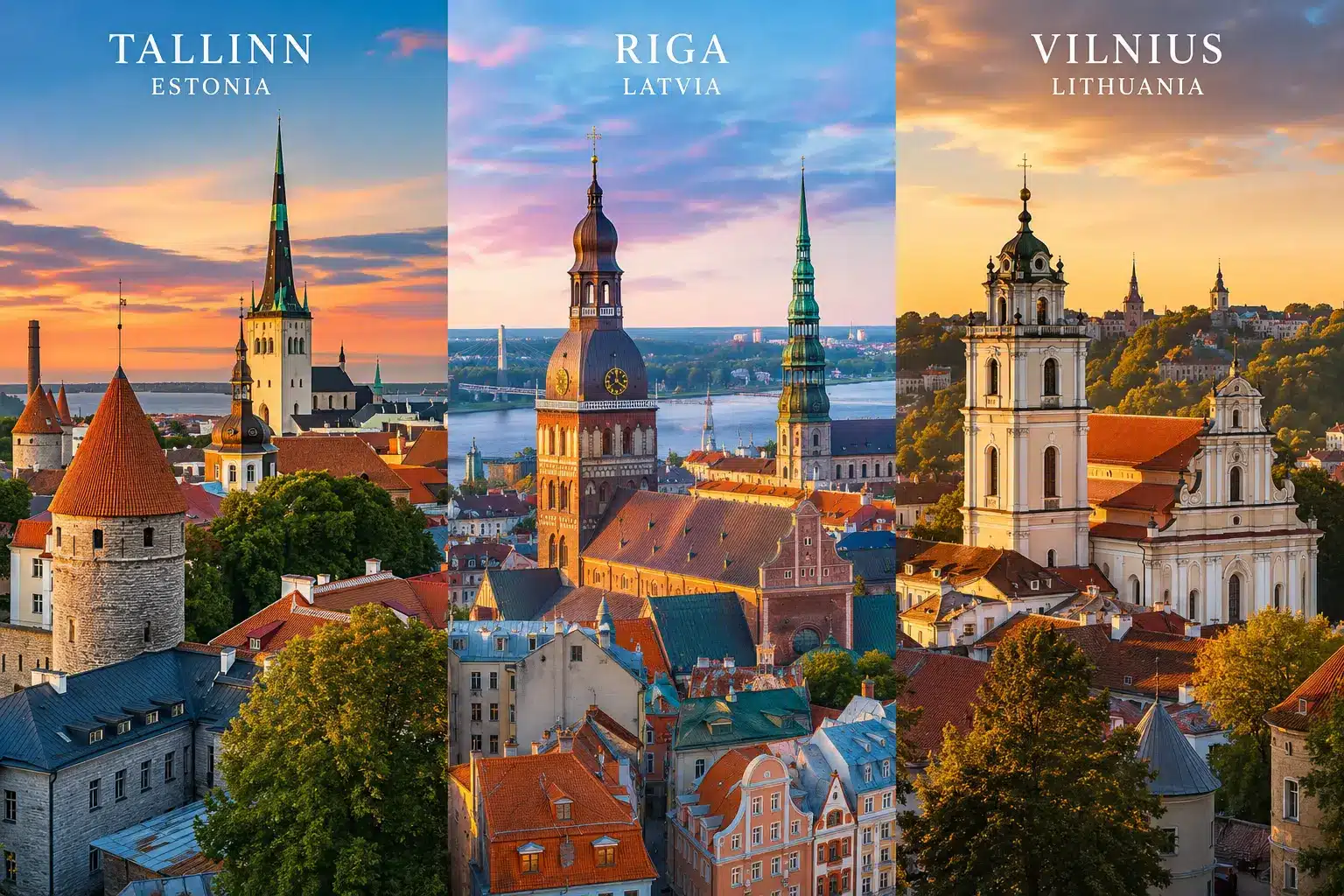
Estonia, Latvia and Lithuania are often grouped together, but they should not be treated as one destination. Tallinn, Riga and Vilnius have different rhythms, and the coastal areas outside the capitals are even more distinct.
Estonia suits travellers interested in medieval streets, islands and northern landscapes. Latvia is practical for combining a large capital with an easy beach trip. Lithuania offers a broader route through food, history, lake towns, port cities and dunes.
This guide covers the places worth adding, the differences between the three countries, likely summer costs, transport options and a route that can be completed without changing hotels every night…Search for the best flight deals for your Baltic trip on Kiwi.com
Quick Answer: Is the Baltic Region Good for a Summer Coolcation?
Yes, particularly for travellers who want to mix sightseeing, beaches and nature without relying on constant high temperatures.
The region has:
- Walkable historic centres
- Sandy Baltic Sea beaches
- Long summer daylight
- Forests, islands, lakes and wetlands
- Direct coaches between Tallinn, Riga and Vilnius
- Accommodation ranging from hostels to spa hotels
- Lower overall costs than many Scandinavian destinations
A visitor mainly interested in islands and medieval architecture will probably find Estonia the strongest starting point. Latvia suits a shorter break because Riga and Jūrmala can be combined without changing accommodation. Lithuania rewards travellers who have enough time to move beyond Vilnius and include places such as Trakai, Kaunas and the western coast.
A quick journey through Tallinn, Riga and Vilnius is possible in one week, but most of that schedule will be spent moving between capitals. Ten days allow more time for neighbourhoods, markets and day trips. Saaremaa, Gauja National Park and the Curonian Spit need additional nights because they are not places that should be squeezed into a few spare hours.
The weather is not guaranteed to remain cool. Heatwaves can reach Northern Europe, while rain and strong coastal wind are also possible. A Baltic itinerary works because it can be adjusted without losing the purpose of the trip.
Tallinn, Riga and Vilnius have enough markets, museums, churches, restaurants and residential districts to fill a cloudy afternoon. When the sun returns, beaches, lakes and forest trails are close enough to reach without changing the entire route.
What Is a Coolcation?
A coolcation is a summer holiday chosen partly because the destination is expected to have milder conditions than a traditional hot-weather resort.
It does not mean travelling somewhere cold.
Most visitors still want sunshine, outdoor meals and time beside the water. They simply prefer weather that allows them to walk through a city, hire a bicycle or visit a national park without avoiding the afternoon completely.
In hotter destinations, the temperature can shape the entire schedule. Sightseeing is moved to the morning, lunch becomes an extended break and outdoor plans restart near sunset.
The Baltic region offers a different rhythm, although the weather can change quickly. A warm morning may turn cloudy. An evening near the coast may require a jumper even when the afternoon felt hot. Rain is possible in every summer month.
That uncertainty is easier to handle when each destination offers several ways to spend the day.
A rainy afternoon in Tallinn can be used for museums, cafés and covered markets. Clear weather in Riga makes the train ride to Jūrmala worthwhile. In Lithuania, a warm day may suit cycling or a beach visit, while cooler conditions work well for Vilnius, Kaunas or Trakai.
This style of travel works particularly well for visitors who enjoy walking, local neighbourhoods and short nature trips. It can also be more comfortable for families with young children, older travellers and anyone who struggles with intense heat.
Northern European summers have attracted visitors for decades. What has changed is the number of travellers now considering these destinations as direct alternatives to the Mediterranean rather than places to visit only after the better-known parts of Europe.
Why Choose the Baltic Countries in Summer 2026?
Tallinn, Riga and Vilnius are far enough apart to feel different but close enough to connect by direct coach. Travellers can cross three countries without taking several flights, dealing with complicated rail changes or losing full days in airports.
The route also gives visitors access to several types of landscape without requiring a major detour.
Tallinn can be followed by wetlands in Lahemaa National Park or a ferry trip towards Estonia’s islands. Riga can be paired with the beach at Jūrmala or the river valleys near Sigulda. Vilnius works well with Trakai, while Klaipėda leads towards the Curonian Spit.
A traveller could stay three nights in Tallinn, continue to Riga for another three and finish in Vilnius without changing hotels every day. Someone with more time could add one coastal or nature stop between the capitals instead of trying to fit several short excursions into the same week.
The capitals do not require a long list of reservations. Much of the experience comes from walking, eating, using public transport and spending time in neighbourhoods outside the main squares.
That creates room for a slower schedule. There is no need to fill every morning and afternoon with booked attractions. A market visit, a neighbourhood walk or a train ride to the coast can be enough for one part of the day…Compare cheap flights to Estonia, Latvia and Lithuania on Kiwi.com
Long Summer Days
June and early July bring very long daylight hours, particularly in Estonia.
A traveller can begin the day late, stop for a long lunch and still have time for a park, viewpoint or waterfront walk in the evening.
This is useful on active trips. Cycling routes, ferry journeys and scenic drives are easier to plan when darkness arrives late.
It also changes the way evenings feel. Dinner does not need to mark the end of the day. In Tallinn, Riga and Vilnius, visitors can return outside afterwards for a walk through quieter streets or along the water.
The same daylight can affect sleep. Rooms without good curtains may become bright early in the morning, especially in June. Light sleepers should check this detail before booking, particularly in apartments where blackout curtains are not guaranteed.
Beaches with Pine Forests and Dunes
Baltic beaches feel different from large Mediterranean resorts.
Many are bordered by dunes, trees and lower buildings rather than long rows of high-rise hotels. The water is cooler, and wind can change the temperature quickly, but the coastline remains useful even when swimming is not the main activity.
Pärnu, Jūrmala and the Curonian Spit are the best-known summer stops, but they do not offer the same experience.
Pärnu feels like a compact resort town where the centre, parks and beach can be reached on foot. Jūrmala stretches across several neighbourhoods and is easy to visit from Riga by train. The Curonian Spit is better suited to cycling, dune walks and overnight stays in smaller settlements.
Visitors should not judge Baltic beaches only by sea temperature. Walking, cycling, coastal cafés and forest paths are often as important as swimming.
A windy afternoon in Jūrmala may still work well for a long beach walk. Pärnu has spas and parks when the water feels too cold. On the Curonian Spit, dunes and cycling routes remain worthwhile even if the day is cloudy.
Costs in the Baltics
The Baltic countries are no longer extremely cheap.
Hotel prices in Tallinn can be high in July, and central restaurants in Riga or Vilnius may cost more than budget travellers expect. Popular coastal destinations can also become expensive during warm weekends.
However, transport and casual food remain manageable in many places. Long-distance coaches are often reasonably priced, urban transport is affordable and there are still guesthouses and apartments outside the most expensive central streets.
Location has a greater effect on cost than the country name alone.
A room in Tallinn’s Old Town may cost more than a similar room in Vilnius. A guesthouse in Nida during August may cost more than a central hotel in Kaunas. Pärnu and Jūrmala can also become expensive when demand rises.
It makes sense to arrange the limited coastal stays before booking the capitals. Beach towns, islands and smaller settlements have fewer rooms, while Tallinn, Riga and Vilnius usually offer more alternatives if prices change.
Weekday stays may also provide better value than weekends in summer resort towns. Travellers who are flexible with dates can sometimes reduce costs by visiting Pärnu or Jūrmala between Monday and Thursday rather than during the busiest part of the week.
Estonia: Tallinn, Pärnu, Saaremaa and Lahemaa
Estonia is the smallest Baltic country by population, but it offers one of the clearest contrasts between capital-city travel and quiet nature.
Tallinn is the main entry point. Pärnu adds a simple beach stay, Saaremaa suits road trips and Lahemaa National Park provides a nature trip close to the capital.
Tallinn
Tallinn’s Old Town is the most visually striking historic centre among the Baltic capitals.
The upper area around Toompea has viewpoints, churches and government buildings. The lower town contains Town Hall Square, merchant houses, narrow lanes and sections of the old city wall.
The central streets become busiest during the day. Early morning and the period after dinner are better for walking without large groups.
A first visit should include the Old Town, but staying there from morning to night gives an incomplete picture of Tallinn.
Kalamaja, west of the centre, has wooden houses, cafés and converted industrial spaces. Telliskivi has become one of the most visited parts of the district, but the residential streets around it are quieter and better for seeing the city beyond its tourist sites.
Kadriorg offers a different atmosphere. The park, museums and surrounding streets make it suitable for a slower afternoon. It is also a better hotel area than the Old Town for travellers who prefer greenery and quieter evenings.
The waterfront has changed significantly in recent years. Walking routes now pass former industrial buildings, harbour areas and newer public spaces. Some parts remain less attractive, but the route provides a useful contrast with medieval Tallinn.
Two days cover the main sights. Three days allow time for Kalamaja, Kadriorg and an evening walk without following a strict timetable..Find hotels in Tallinn, Riga and Vilnius. on Klook.com
Pärnu
Pärnu is Estonia’s main summer resort and a practical stop between Tallinn and Riga.
The town has a wide beach, parks, spa hotels and a compact centre. Local visitors arrive in large numbers when the weather turns warm, particularly on weekends.
Pärnu does not need a tightly planned sightseeing programme.
A typical day can begin with breakfast in the centre, continue through the parks and finish near the beach. Cycling is easy because the terrain is flat, and the town is small enough to explore without spending much time on transport.
Spa hotels give visitors another option when the weather is too cool for a full beach day. That makes Pärnu more dependable than a place where the only attraction is swimming.
One night works for a short stop. Two nights are better for travellers who want time to rest rather than arriving late and leaving again the next morning.
Saaremaa
Saaremaa is Estonia’s largest island and deserves more than a day trip.
Kuressaare is the main base. Its castle is the best-known attraction, but the island’s stronger appeal lies in the roads, villages, forests, churches and coastal viewpoints outside town.
A car makes a significant difference. Public transport exists, but it does not provide the freedom needed to stop in smaller places.
Travellers should allow at least two nights. Three or four nights suit anyone who wants a slower road trip.
The island works well for couples, families with a car and visitors who prefer quiet evenings to nightlife.
Lahemaa National Park
Lahemaa National Park lies east of Tallinn and can be visited without adding an island crossing to the trip.
The park includes forests, bogs, coastal settlements and manor houses. Boardwalk trails make some wetland areas easy to explore.
A car provides the most flexibility, although day tours and limited public transport can work for selected routes.
For travellers with only one spare day outside Tallinn, Lahemaa is easier to fit in than Saaremaa and still provides a complete change of scenery.
Who Should Choose Estonia?
Estonia suits visitors who want:
- Medieval architecture
- Islands and ferry journeys
- Forests and wetlands
- A possible extension to Helsinki
- A quieter road-trip atmosphere
Tallinn can be the most expensive Baltic capital in summer, especially when accommodation is booked late.
A better Estonia itinerary includes at least one place outside the capital. Pärnu is easiest, Lahemaa is closest and Saaremaa provides the strongest change of pace.
Latvia: Riga, Jūrmala, Sigulda and Cēsis
Latvia sits between Estonia and Lithuania, making it the easiest country to include in almost any Baltic itinerary. Travellers moving north to south—or in the opposite direction—naturally pass through Riga, and that makes Latvia much more than a stop between two capitals.
Many first-time visitors expect Riga to be another version of Tallinn, but the city has its own character. It is larger, busier and spread across a wider area. Medieval streets remain an important part of the city, yet they represent only one chapter of the experience.
Latvia also has one advantage that becomes obvious during summer: it is remarkably easy to leave the city without travelling far. A short train journey leads to Jūrmala, while forests, castles and river valleys can be reached within a few hours.
For travellers with limited time, Latvia often provides the best balance between urban sightseeing and time by the sea.
Riga
Riga rewards travellers who are willing to leave the postcard streets behind.
The Old Town is where most visitors begin. Church towers, restored merchant houses, narrow lanes and open squares create an attractive first impression, particularly during the early morning before cafés fill and walking tours begin.
Instead of trying to photograph every building, spend time noticing the details that make the city different. Decorative doorways, quiet courtyards and side streets often become the most memorable parts of a walk through Riga.
From the Old Town, continue towards the Central Market.
Unlike markets created mainly for visitors, Riga Central Market still serves local residents. Fresh vegetables, smoked fish, bread, pastries, cheese, flowers and seasonal fruit fill the large market halls. Even travellers who are not shopping often enjoy spending an hour watching daily life rather than moving immediately to another attraction..Compare Baltic hotels and choose the best stay for your budget on Klook.com
The Art Nouveau district shows another side of Riga.
Around Alberta Street and the surrounding neighbourhoods, apartment buildings display elaborate façades, carved faces, balconies and decorative stonework. It is one of the best collections of Art Nouveau architecture in Europe, but it never feels like an outdoor museum because people still live and work there.
Parks also play an important role in the city.
The canal that circles part of the historic centre creates pleasant walking routes between attractions. On warm afternoons, the parks provide shade and a quieter atmosphere than the busiest streets.
Many visitors spend one day in the Old Town and leave believing they have seen Riga.
They usually have not.
Neighbourhood cafés, local bakeries, canal walks and residential streets explain the city better than another hour in the busiest square.
Two full days are enough for the main highlights.
Three days allow visitors to explore the city without rushing and still include a day beside the Baltic Sea.
Jūrmala
Jūrmala is Latvia’s best-known seaside destination, but describing it as a single town can be misleading.
It stretches for many kilometres along the coast, with several neighbourhoods connected by train. Each has a slightly different atmosphere.
Majori attracts the largest number of visitors because restaurants, cafés and shops sit close to the beach.
Dzintari feels a little quieter while still remaining convenient.
Travellers looking for a slower experience often continue beyond these areas where the beaches become less crowded.
The beach itself is broad, sandy and backed by pine forest.
Unlike many Mediterranean resorts, large hotel blocks do not dominate the coastline. Instead, walking paths disappear into the trees before returning to the sand.
Swimming depends on the weather.
During warm periods, the sea is pleasant enough for many visitors. On cooler days, walking along the shoreline or cycling through the forest can be just as enjoyable.
That flexibility explains why Jūrmala remains popular even when the forecast is mixed.
One useful tip is to stay until evening.
Day visitors usually return to Riga before dinner, leaving the beach noticeably quieter. Watching the sunset or eating near the coast often becomes one of the most relaxed moments of the trip.
Accommodation varies considerably.
Hotels close to the station and beach are convenient but become expensive in high season. Guesthouses a little farther away can offer better value if a longer walk does not matter.
Sigulda and Gauja National Park
Travellers wanting to exchange city streets for forests usually head towards Sigulda.
Often called the gateway to Gauja National Park, the town provides access to walking trails, river valleys, castles and caves.
The scenery changes quickly.
Within a short distance of the railway station, forests replace apartment blocks and wooden paths begin crossing valleys and woodland.
Turaida Castle is the area’s best-known attraction.
Many visitors arrive only for the castle before returning to Riga, but that approach misses much of what makes the region enjoyable.
Several walking trails connect viewpoints, bridges and quieter woodland areas. Even a short hike reveals landscapes very different from the Baltic capitals.
Cyclists also use the region during summer.
Roads are generally quiet outside the busiest weekends, making the area attractive for visitors who prefer exploring slowly instead of following organised tours.
A single day is enough to see the main attractions.
An overnight stay allows travellers to enjoy the park early in the morning when trails are quieter and temperatures are usually more comfortable.
Cēsis
Cēsis is often overlooked because of its proximity to Sigulda, yet the town deserves attention in its own right.
Its historic centre is compact and easy to explore on foot.
Stone streets, small cafés and castle ruins create a quieter atmosphere than Riga without feeling empty.
Visitors interested in photography often appreciate Cēsis because daily life continues around the historic buildings rather than being dominated by tourism.
Restaurants tend to be smaller and more local, while parks provide places to stop without the crowds found in larger cities.
The castle complex remains the main attraction.
Instead of rushing through it, allow time to walk around the surrounding grounds and nearby streets. The combination gives a better impression of the town than focusing only on the castle itself.
Cēsis works particularly well as a one-night stop for travellers driving through Latvia.
It also fits naturally into an itinerary that includes Gauja National Park.
Who Should Choose Latvia?
Latvia suits travellers who enjoy variety without spending long hours travelling.
It works particularly well for:
- City breaks with easy access to the coast
- Architecture and historic neighbourhoods
- Local markets and cafés
- Short train journeys instead of long transfers
- Walkable towns combined with nature
Many visitors underestimate how much there is to see outside Riga’s Old Town.
Adding Jūrmala creates an entirely different day by the sea.
Choosing Sigulda or Cēsis introduces forests, castles and quieter landscapes.
Together, these places show why Latvia deserves more than a quick overnight stop between Estonia and Lithuania.
Lithuania: Vilnius, Trakai, Kaunas, Klaipėda and the Curonian Spit
Lithuania feels different from the moment most travellers arrive in Vilnius.
The capital has a slower rhythm than Riga and a more open layout than Tallinn. Streets widen into squares before narrowing again between churches, courtyards and old houses. Instead of concentrating everything inside one compact historic centre, Vilnius encourages visitors to keep walking because another interesting street is usually only a few minutes away.
That sense of variety continues across the country.
Within one journey, travellers can move from lakes and castles to modernist architecture, then continue towards fishing villages, sand dunes and the Baltic coast.
For visitors planning to spend a week or more in one Baltic country, Lithuania often provides enough contrast to keep the itinerary interesting without crossing another border.
Vilnius
Vilnius is one of those cities that rewards curiosity more than speed.
Many people arrive with a short list of landmarks, but the city’s atmosphere is found just as much in its side streets as in its famous buildings.
Cathedral Square is the natural starting point.
From there, it is easy to reach Gediminas Tower, which overlooks the rooftops of the Old Town. The climb is not difficult, and the view explains how green the city really is. Forested hills surround the centre, making Vilnius feel less densely built than many European capitals.
Pilies Street remains the busiest route through the Old Town.
Restaurants, souvenir shops and cafés line the street, yet some of the most enjoyable places sit only a few metres away down quieter lanes.
Rather than following the crowds from one attraction to another, spend time wandering through courtyards and residential streets. Some contain bookshops, galleries or small cafés that many visitors walk past without noticing.
The Gate of Dawn continues to attract pilgrims as well as tourists, giving one part of the city a noticeably different atmosphere.
Later in the day, many visitors cross into Užupis.
Although often described as an artistic district, it feels more like a neighbourhood where independent cafés, studios and local life happen to exist alongside visitors. Early morning or late afternoon usually provides the calmest experience.
Vilnius is also one of the easiest Baltic capitals for food.
Traditional Lithuanian dishes, bakeries, speciality coffee shops and modern restaurants are spread throughout the centre rather than concentrated in one tourist zone.
Instead of booking every meal in advance, leave space to stop wherever looks interesting.
Two full days provide enough time for the main sights.
Three days make the visit much more relaxed and leave room for neighbourhoods, museums or an easy trip outside the city.
Trakai
Less than an hour from Vilnius, Trakai offers one of Lithuania’s most recognisable landscapes.
The island castle immediately attracts attention, but limiting the visit to photographs of the castle misses much of what makes the town enjoyable.
Lakes surround the historic centre.
Walking paths follow the shoreline, boats move slowly across the water during summer and wooden houses create a quieter atmosphere than the capital.
Arriving early changes the experience.
By late morning, tour groups begin filling the bridge leading to the castle. Earlier in the day, visitors can walk around the lakes with much more space.
Food is another reason to stay longer.
Trakai is closely associated with the Karaim community, whose traditional pastry, kibinai, remains one of the town’s best-known local dishes.
Instead of eating immediately beside the castle, walk a little farther through town where smaller restaurants often provide a calmer atmosphere.
A half-day trip covers the castle.
A full day allows enough time to enjoy the lakes, stop for lunch and walk beyond the busiest streets.
Kaunas
Kaunas is frequently overlooked because many visitors concentrate only on Vilnius.
That is unfortunate because the city offers an entirely different experience.
Its identity is closely connected with twentieth-century modernist architecture rather than medieval streets.
Laisvės Alėja, the city’s broad pedestrian avenue, links the newer centre with the historic district. Cafés, restaurants and shops line the route, making it one of the easiest places in Lithuania for a slow afternoon walk.
The Old Town is smaller than Vilnius but still contains attractive squares, churches and Kaunas Castle.
Unlike many tourist centres, daily life remains clearly visible. Students, office workers and local families share the same streets as visitors.
Museums covering Lithuanian history, art and the interwar period add more reasons to stay than many travellers expect.
One full day usually provides enough time to understand the city.
Those interested in architecture or museums may prefer staying overnight rather than returning immediately to Vilnius.
Klaipėda
Klaipėda serves a different purpose from Lithuania’s inland cities.
As the country’s main port, it combines commercial activity with a compact historic centre influenced by German architecture.
Many visitors treat Klaipėda only as the departure point for the Curonian Spit.
That approach works, but the city deserves at least a few hours before boarding the ferry.
Small squares, sculptures, riverside cafés and restored warehouses make the centre pleasant to explore on foot.
The harbour also provides a reminder that Lithuania’s relationship with the Baltic Sea extends beyond beaches and tourism.
An overnight stay becomes useful for travellers catching an early ferry or those wanting a relaxed evening before continuing towards the coast.
The Curonian Spit
Few landscapes in Northern Europe look quite like the Curonian Spit.
This narrow peninsula separates the Baltic Sea from the Curonian Lagoon and combines pine forests, beaches, dunes and small fishing settlements into one protected landscape.
Nida is the best-known base.
The town remains compact enough to explore on foot while offering bicycle rental, cafés, guesthouses and easy access to surrounding nature.
Cycling is one of the most enjoyable ways to experience the peninsula.
Instead of driving directly from one viewpoint to another, visitors can follow forest paths that connect beaches, villages and observation areas.
The famous sand dunes provide wide views across both the lagoon and the sea.
Conditions change noticeably throughout the day. Early morning often brings calm weather, while afternoon wind reshapes the dunes and creates a different atmosphere.
Although many visitors arrive on day trips from Klaipėda, staying overnight transforms the experience.
Once the last ferries carrying day visitors leave, the beaches become quieter, restaurants are less crowded and evening walks feel completely different.
Accommodation should be booked well in advance during July and August because the number of available rooms is limited.
Who Should Choose Lithuania?
Lithuania suits travellers looking for a journey with several distinct stages rather than one city followed by a return flight.
It is especially rewarding for visitors interested in:
- Historic cities with a relaxed atmosphere
- Local food and café culture
- Lakes and castles
- Modernist architecture
- Cycling holidays
- Coastal landscapes and nature
The country’s greatest strength is how different each stop feels.
Vilnius, Trakai, Kaunas, Klaipėda and the Curonian Spit all offer separate experiences instead of repeating the same scenery.
Travellers who allow enough time between destinations usually discover that Lithuania is far more varied than they expected before arriving.. Read our Latvia travel guide here
Estonia vs Latvia vs Lithuania: Which Country Fits Your Trip?
The three Baltic countries are close enough to combine, but each offers a different style of holiday.
Estonia feels the most northern, particularly in Tallinn and the coastal areas around the capital. Latvia is the easiest country for travellers who want a city break with a beach close by. Lithuania offers the widest range of stops for anyone planning to remain in one country for a week or longer.
The right choice depends less on which country is “best” and more on what you want to do each day.
Choose Estonia for Medieval Streets, Islands and a Northern Atmosphere
Estonia is a strong starting point for travellers who want a compact capital followed by quieter landscapes.
Tallinn’s Old Town has the clearest medieval character of the three capitals. City walls, towers, steep lanes and viewpoints give visitors an immediate sense of place.
Outside Tallinn, Estonia changes quickly.
Pärnu offers a simple beach stop, Lahemaa National Park provides forests and wetlands close to the capital, and Saaremaa suits travellers who want several days of quiet roads, villages and coastal scenery.
Estonia works particularly well for:
- First-time visitors to the Baltic region
- Couples
- Travellers interested in medieval architecture
- Island road trips
- Nature breaks
- Trips that may continue to Finland
The main trade-off is cost.
Tallinn can be more expensive than Riga or Vilnius, especially during summer weekends and major events. Accommodation inside the Old Town often carries the highest prices.
Travellers who choose Estonia should avoid spending the entire trip in Tallinn. Even one extra stop changes the experience considerably.
Choose Latvia for Riga, Jūrmala and Shorter Travel Days
Latvia suits people who want to see several different places without covering large distances.
Riga provides a larger-city experience than Tallinn or Vilnius. Its markets, parks, Art Nouveau buildings and residential districts give travellers more than a compact historic centre.
Jūrmala is close enough for a day trip, while Sigulda and Cēsis introduce forests, castles and smaller towns.
Latvia works particularly well for:
- Long weekends
- City-and-beach trips
- Travellers relying on public transport
- Architecture and market visits
- Families who want shorter transfers
- Visitors who prefer one central base
A traveller can stay in Riga and take day trips without packing every morning.
That makes Latvia practical for anyone who wants variety but dislikes changing hotels.
The main risk is underestimating the country.
Some visitors spend one night in Riga while travelling between Estonia and Lithuania. That leaves little time for the Central Market, Art Nouveau district, Jūrmala or Gauja National Park.
Choose Lithuania for Food, Culture and a Longer Route
Lithuania is often the strongest choice for travellers who want to spend an entire week in one country.
Vilnius, Trakai, Kaunas, Klaipėda and the Curonian Spit create a journey with clear changes in scenery and atmosphere.
The route can begin with churches and cafés in Vilnius, continue to the lakes around Trakai, move through the modernist streets of Kaunas and finish beside the Baltic Sea.
Lithuania works particularly well for:
- Food and café-focused trips
- Travellers interested in history
- Cycling holidays
- Lake visits
- Coastal nature
- Longer single-country itineraries
The main difficulty is distance.
Vilnius lies far from the western coast, so visitors need enough time to include Klaipėda and the Curonian Spit without spending several days rushing between transport connections.
A short visit should focus on Vilnius, Trakai and perhaps Kaunas. The coast is better added when the trip is long enough to include at least one overnight stay.
Quick Baltic Country Comparison
| Travel interest | Best choice |
|---|---|
| Medieval old town | Estonia |
| Islands | Estonia |
| Easy beach trip from the capital | Latvia |
| Art Nouveau architecture | Latvia |
| Large city atmosphere | Latvia |
| Local food and café culture | Lithuania |
| Lakes and castles | Lithuania |
| Sand dunes and cycling | Lithuania |
| Short three-day trip | Latvia |
| One-week single-country journey | Lithuania |
| Road trip | Estonia or Lithuania |
| First Baltic visit | Estonia or Latvia |
The table is useful for narrowing the options, but flight routes and available time may decide the final choice.
Travellers arriving through Helsinki often find Tallinn the easiest first stop. Riga is useful for a central route because it sits between the other two capitals. Lithuania connects naturally with Poland and the rest of Central Europe.
Which Baltic Capital Should You Visit First?
Tallinn, Riga and Vilnius should not be treated as interchangeable city breaks.
Each offers a different experience.
Tallinn
Tallinn gives visitors the strongest first impression.
The Old Town is compact, photogenic and easy to explore in a short time. Its viewpoints and preserved walls make it the most obvious choice for travellers interested in medieval Europe.
The busiest streets can feel crowded, especially in the middle of the day.
Staying one extra day allows time for Kalamaja, Kadriorg and the waterfront, where the city feels less dependent on tourism.
Riga
Riga feels broader and more urban.
The Old Town is only one part of the city. The Central Market, Art Nouveau district, canal parks and residential neighbourhoods give visitors more space to explore.
It is the best choice for travellers who enjoy architecture, markets and larger cities.
Riga also has the easiest beach connection because Jūrmala can be reached directly by train.
Vilnius
Vilnius has a softer pace.
Its Old Town is large, but it feels less enclosed than Tallinn’s. Churches, courtyards and cafés are spread across a wider area.
The city works well for travellers who prefer unplanned walks and slower meals rather than a strict sightseeing list.
Vilnius also provides the easiest access to Trakai, which adds lakes and a castle without requiring a long journey.
Baltic Summer Weather: What to Expect
Summer in Estonia, Latvia and Lithuania can include warm afternoons, cool evenings, wind, rain and occasional periods of strong heat.
The weather does not remain the same across the region.
Coastal areas often feel cooler because of the wind from the Baltic Sea. Inland cities such as Vilnius can become warmer during still weather.
Travellers should avoid packing as if they are visiting either a cold northern country or a hot Mediterranean resort.
Both assumptions can cause problems.
June
June brings some of the longest days of the year.
It is a good month for walking, cycling and road trips because there is plenty of daylight. The evenings remain bright, especially in Estonia.
The weather may still feel cool at night, and the Baltic Sea can be too cold for long swims.
June often suits travellers who care more about outdoor activities than guaranteed beach weather.
It can also be quieter than July, although local festivals and public holidays may increase demand in some areas.
July
July is usually the warmest and busiest month.
It offers the best chance of beach weather, outdoor dining and long evenings beside the coast.
The same conditions also bring higher hotel prices and larger crowds.
Tallinn, Pärnu, Jūrmala, Vilnius and Nida can all become busy during July weekends.
Hot weather is possible.
Older apartments and small hotels may not have air conditioning, so travellers should check this before booking. A room under the roof can become uncomfortable during a heatwave even in Northern Europe.
July suits travellers who want the strongest chance of summer conditions and do not mind paying more for popular dates.
August
August can still provide warm weather, particularly during the first half of the month.
The evenings begin to feel cooler, and the days gradually shorten.
Coastal wind may become more noticeable.
The main advantage is that some destinations become calmer later in the month as local summer holidays end.
August works well for travellers who want a balance between warm weather and fewer visitors.
Can the Baltics Have Heatwaves?
Yes.
The idea of a coolcation should not be confused with permanently low temperatures.
Estonia, Latvia and Lithuania can all experience unusually hot periods. City centres, public transport and apartments without ventilation may become uncomfortable.
Before booking summer accommodation, check whether the room has:
- Air conditioning
- A fan
- Windows that open
- Good ventilation
- Thick curtains
- Shade during the afternoon
This matters most in central apartments located on upper floors.
When temperatures rise, adjust the daily schedule.
Use the morning for city walking, spend the middle of the day in museums or restaurants and return outside later in the evening.
Coastal areas, lakes and forests may also feel more comfortable than city centres.
What to Pack for a Baltic Summer
Packing for the Baltics requires more variety than packing for a standard beach holiday.
A useful list includes:
- Light shirts
- Shorts
- Light trousers
- Comfortable walking shoes
- A thin jumper
- A waterproof jacket
- A small umbrella
- Swimwear
- Sunscreen
- Sunglasses
- Insect repellent
- A reusable water bottle
- A small day bag
- A power bank
Comfortable shoes are essential.
Tallinn, Riga and Vilnius all have cobbled streets, uneven pavements and long walking routes.
A thin jumper or light jacket is useful for ferry journeys, windy beaches and evening walks.
Travellers planning to visit forests or national parks should bring shoes with better grip. Wet boardwalks and muddy paths can become slippery after rain.
A power bank is useful on long travel days, especially when using digital tickets, maps and transport apps.
Which Baltic Country Is Best for Families?
Latvia is often the easiest option for a short family trip.
Riga has parks, markets and city attractions, while Jūrmala provides a wide beach close to the capital.
Families can stay in one hotel and avoid complicated transfers.
Estonia also works well, particularly when Tallinn is combined with Pärnu. Saaremaa suits families with a rental car and enough time for a slower route.
Lithuania offers the most variety, but the distances require better planning. Trakai and the coast are strong family stops, although trying to include both in a short visit may create too much travel.
Families should choose two or three bases rather than moving every night.
The trip becomes much easier when children have time to rest and the schedule does not depend on catching an early coach every morning.
Which Baltic Country Is Best for Couples?
Estonia suits couples looking for old streets, islands and quiet coastal scenery.
Tallinn works well for a short city break, while Saaremaa adds a slower few days away from the capital.
Lithuania is another strong option for couples who enjoy food, cafés and cycling. Vilnius and Nida create a good city-and-coast combination.
Latvia works best for couples with limited time. Riga and Jūrmala can be combined in one weekend without a complicated route.
Which Baltic Country Is Best for Solo Travellers?
All three countries are manageable for solo visitors.
The capitals are walkable, public transport is straightforward and long-distance coaches connect the main cities.
Latvia is practical for a short solo trip because Riga, Jūrmala and Sigulda are easy to combine.
Estonia suits travellers continuing towards Finland.
Lithuania is better for solo visitors who want a longer route through several cities and coastal stops.
Accommodation is usually the main challenge.
Private rooms become expensive in summer, particularly near beaches and in Tallinn. Hostels and simple guesthouses offer better value for travellers who do not need a private hotel room.
Which Baltic Country Is Cheapest?
Lithuania is often the most affordable overall, although the difference depends on the route.
Tallinn is usually the most expensive capital. Riga often offers better value outside the Old Town. Vilnius has a wide range of cafés and accommodation, but prices have also risen.
Coastal destinations can cost more than inland cities.
Nida, central Jūrmala and Pärnu may be more expensive than Vilnius or Kaunas during a warm summer weekend.
Travellers should compare actual dates rather than assuming one country will always be cheaper.
A flexible route can save money.
For example, someone who finds Tallinn expensive may stay in Kalamaja or Kadriorg rather than the Old Town. In Riga, Centrs can offer better value than the most tourist-focused streets. In Vilnius, the New Town may provide more modern rooms at lower prices than the historic centre.
How Long Should You Spend in the Baltics?
The ideal length depends on whether the trip focuses on capitals or includes nature and the coast.
Three or four days are enough for one capital with a nearby day trip.
One week works well for two countries or a fast journey through all three capitals.
Ten days provide a more comfortable route with time for Jūrmala, Trakai or another stop outside the main cities.
Two weeks allow travellers to include Saaremaa, Gauja National Park or the Curonian Spit without rushing.
The best plan is not always the one with the most destinations.
A slower journey through two countries often feels more complete than a rushed route through all three.
A 10-Day Baltic Coolcation Itinerary
A ten-day route gives travellers enough time to visit Tallinn, Riga and Vilnius without turning every day into a transfer day.
The itinerary below focuses on the three capitals and adds Jūrmala, Trakai and Kaunas. It does not include Saaremaa, Gauja National Park or the Curonian Spit because those places deserve more time than a rushed stop.
Travellers with twelve to fourteen days can add one of those longer side trips without making the journey feel crowded.
Day 1: Arrive in Tallinn
Use the first afternoon to get familiar with Tallinn rather than trying to complete a full sightseeing list.
Begin around Town Hall Square and walk through the lower part of the Old Town. Continue towards Toompea Hill for one of the main viewpoints over the rooftops and city walls.
The centre becomes quieter later in the evening, especially after organised day tours leave. A second walk after dinner often feels more relaxed than the first.
Travellers arriving late should avoid booking major attractions for the same day. Check in, eat nearby and leave the main sightseeing for the morning.
Day 2: Tallinn Beyond the Old Town
Spend the morning in Kalamaja and Telliskivi.
The wooden houses, cafés and former industrial spaces create a clear contrast with medieval Tallinn. Walking through the surrounding residential streets gives a better picture of the neighbourhood than staying only inside the busiest commercial area.
Continue to Kadriorg in the afternoon.
The park, museums and quieter streets provide an easier pace after a morning of walking. Travellers who do not want to visit a museum can still enjoy the grounds and nearby residential area.
Finish the day with a waterfront walk or return to the Old Town after the daytime crowds have thinned.
Day 3: Tallinn to Riga
Travel from Tallinn to Riga by long-distance coach.
A direct journey is the easiest choice on a ten-day itinerary. Pärnu is well placed between the two capitals, but adding it for only a few hours creates extra luggage handling and turns the day into a series of connections.
Travellers who strongly want Pärnu should stay overnight and extend the trip by one day.
After arriving in Riga, check in and take a short walk through the Old Town. Keep the evening light, especially after several hours on the road.
Day 4: Riga Old Town, Central Market and Art Nouveau District
Start in Riga’s Old Town before the central streets become busy.
Walk through the main squares and church areas, then continue towards the Central Market. The market works well before lunch because more stalls are open and the halls feel active.
Spend the afternoon around the canal parks and the Art Nouveau district.
Alberta Street is the best-known address, but the surrounding streets deserve time as well. Looking only at one block gives a limited impression of the area.
Return towards the centre through the parks rather than following the same route back.
Day 5: Jūrmala
Take the train from Riga to Majori or Dzintari.
Majori is more convenient for cafés, restaurants and the busiest part of the beach. Dzintari is useful for parks and a slightly quieter atmosphere.
Do not build the day around swimming alone. Baltic weather can change quickly, and the beach remains worthwhile for walking or cycling even if the water feels cold.
Spend enough time to explore beyond the station area. The coastline is long, and walking away from the busiest access points usually leads to quieter stretches.
Return to Riga in the evening, or stay overnight if the beach is one of the main reasons for the trip.
Day 6: Riga to Vilnius
Travel south by coach.
After arriving in Vilnius, check in and begin around Cathedral Square. Continue along Pilies Street and through the nearby lanes without trying to cover the full Old Town.
Vilnius works well for an unplanned first evening. Courtyards, churches and cafés appear naturally along the walking route.
Dinner in the centre is easy to arrange without travelling far from the hotel.
Day 7: Vilnius
Begin with Gediminas Tower or the Hill of Three Crosses before the middle of the day.
Both provide useful views, although they show the city from different angles.
Continue towards Užupis and spend part of the afternoon exploring the smaller streets nearby. The main entrance attracts the largest number of visitors, while quieter areas sit only a short walk away.
Leave time for food and cafés. Vilnius is not a city that needs to be rushed from one landmark to another.
Day 8: Trakai
Travel to Trakai in the morning.
Arriving early gives visitors a better chance of walking across the bridge before large groups reach the castle.
After visiting the castle, continue around the lakes and through the town. A lunch stop for kibinai adds more to the visit than returning immediately to Vilnius.
Those who enjoy walking can stay for most of the day. Travellers interested only in the castle can return earlier and use the late afternoon in Vilnius.
Day 9: Kaunas
Travel to Kaunas for a full-day visit.
Begin around Laisvės Avenue and walk towards the Old Town. The pedestrian route makes the city easy to explore without relying heavily on public transport.
Include Town Hall Square, Kaunas Castle and one museum or architectural area rather than trying to see everything.
Travellers who prefer a slower pace can stay overnight. Those returning to Vilnius should check the evening schedule before beginning the day. Read our Estonia travel guide here
Day 10: Departure
Use the final morning for a market, museum or neighbourhood walk close to the accommodation.
Avoid planning a distant day trip before a flight or long train journey. Delays can occur, and the final hours are better used near the departure city.
Travellers with extra days can extend the route in one direction:
- Add Saaremaa after Tallinn for an island road trip.
- Add Sigulda and Cēsis after Riga for hiking and castles.
- Add Klaipėda and the Curonian Spit after Vilnius for the strongest coastal extension.
Choosing one extension usually creates a better trip than adding several places for only a few hours each.
Getting Around Estonia, Latvia and Lithuania
The Baltic capitals are easier to connect than many first-time visitors expect.
Long-distance coaches remain the most practical option for most multi-country journeys. They run directly between Tallinn, Riga and Vilnius, usually with comfortable seats, luggage storage and central departure points.
Tickets should be booked in advance during busy summer weekends, but there is rarely a need to organise every journey several months ahead.
Travelling by Coach
Coaches work best for:
- Tallinn to Riga
- Riga to Vilnius
- Tallinn to Pärnu
- Riga to Sigulda or Cēsis
- Vilnius to Kaunas
The main advantage is simplicity.
Travellers board in one city and arrive in another without changing trains or travelling to a distant airport. Luggage is stored underneath, and most services stop close to the centre.
Keep valuables, medication and travel documents in a small bag inside the coach rather than in the luggage compartment.
Travelling by Train
Trains are useful for selected domestic routes.
The Riga to Jūrmala journey is short and straightforward. Vilnius to Trakai and Vilnius to Kaunas are also practical rail trips.
Train travel between all three capitals is improving, but it may still involve less convenient schedules or connections than direct coaches.
Check the actual journey time before assuming the train will be faster.
Renting a Car
A car is not necessary for a route limited to Tallinn, Riga and Vilnius.
It becomes much more useful for:
- Saaremaa
- Lahemaa National Park
- Gauja National Park beyond Sigulda
- Smaller Latvian towns
- Rural Lithuania
- The Curonian Spit
- Coastal road trips
Driving allows travellers to reach villages, viewpoints and trails that public transport serves only a few times per day.
Before booking, check whether the rental company allows the car to cross all three Baltic borders. One-way international drop-off fees can be high.
Parking is another consideration. Historic centres often have limited or paid parking, so keeping a rental car during several city days may create unnecessary expense.
Getting Around the Capitals
Tallinn, Riga and Vilnius are all walkable in their central areas.
Public transport is useful for neighbourhoods, parks, stations and places outside the Old Town.
Digital tickets and transport apps are common, but travellers should still check whether a local ticket requires activation before boarding.
Ride-hailing services are widely available in the capitals. They can be useful after dark, during rain or when travelling with luggage.
Typical Baltic Travel Budget
The cost of a Baltic trip depends heavily on season, location and accommodation style.
Tallinn usually has the highest average prices, while Vilnius and Kaunas often provide better value. Coastal destinations can cost more than the capitals during July and August because room supply is limited.
The estimates below are per person per day and do not include international flights.
| Travel style |
Estimated daily budget |
|---|---|
| Budget |
€55–€85 |
| Mid-range |
€100–€160 |
| Comfortable |
€180+ |
Budget Travel
A budget traveller may stay in hostels, simple guesthouses or shared apartments.
Public transport, supermarket meals, bakeries and casual lunch restaurants help keep daily costs under control.
Free walking routes, parks, beaches and neighbourhoods can fill much of the itinerary without expensive attractions.
The lower end of the budget is easier outside Tallinn and the main seaside towns.
Mid-Range Travel
A mid-range budget usually covers:
- A private room or central apartment
- Breakfast or café meals
- One restaurant meal per day
- Paid attractions
- Public transport
- Occasional taxis
- Long-distance coach tickets
This is the most realistic range for couples who want comfort without choosing luxury hotels.
Booking accommodation early matters more than cutting small food costs. A badly timed summer hotel can add more to the total than several restaurant meals.
Comfortable Travel
Travellers choosing boutique hotels, spa stays, private transfers and higher-end restaurants should expect the daily total to rise quickly.
This is especially true in Tallinn, Nida, Jūrmala and Pärnu during peak dates.
A comfortable budget also allows more flexibility, including last-minute transport changes, larger rooms and accommodation close to major sights.
Where to Stay
The most famous district is not always the best place to sleep.
Noise, restaurant prices, early deliveries and large tour groups can affect central accommodation. Staying one neighbourhood outside the busiest streets often provides better rooms and quieter evenings.
Where to Stay in Tallinn
Old Town: Best for a short first visit and travellers who want to walk directly to the main sights.
Kalamaja: Better for cafés, wooden houses and a more residential atmosphere.
Kadriorg: Suitable for parks, museums and quieter evenings.
The Old Town is convenient, but rooms can be expensive and noisy. Check whether the property has lifts, air conditioning or easy taxi access, especially in older buildings.
Where to Stay in Riga
Old Town: Useful for a weekend trip and first-time visitors.
Centrs: Better for restaurants, parks, transport and the Art Nouveau district.
Jūrmala: Best for travellers planning several beach days rather than one day trip.
Centrs often provides a stronger balance between price and location. It also avoids some of the evening noise found in the busiest parts of the Old Town.
Where to Stay in Vilnius
Old Town: Convenient for churches, restaurants and first-time sightseeing.
Užupis: Good for a quieter stay with cafés and local streets nearby.
New Town: Useful for modern hotels, transport links and better-value rooms.
Vilnius has a larger historic centre than visitors may expect. Check the walking distance carefully rather than relying only on a property being described as “central.”
Common Planning Mistakes
A Baltic journey can look simple on a map, but poor timing still creates unnecessary stress.
Trying to See Too Much
Three capitals, several beaches, islands and national parks do not fit comfortably into one week.
A short stop may add another name to the itinerary without adding much to the experience.
Choose fewer overnight bases and give each one enough time.
Changing Hotels Every Night
Packing, checking out, reaching the station and waiting for transport consume more time than the journey itself.
Two or three nights in each base make the trip easier and reduce the chance of losing belongings during frequent moves.
Staying Only in the Old Towns
The historic centres are important, but they show only one side of each capital.
Kalamaja and Kadriorg add depth to Tallinn. Riga’s Central Market and Art Nouveau district are essential. Užupis and Vilnius’s quieter courtyards provide a different view of the Lithuanian capital.
Packing Only for Hot Weather
Summer can bring heat, rain, wind and cool evenings within the same trip.
A light waterproof jacket and jumper take little space and are useful near the coast.
Underestimating Travel to the Coast
Klaipėda and the Curonian Spit are not quick additions to a short Vilnius trip.
Saaremaa also requires ferry and road time.
These places are better treated as overnight destinations rather than rushed day trips.
Confusing the Baltics with the Balkans
The Baltic countries are Estonia, Latvia and Lithuania in Northern Europe.
The Balkans lie in southeastern Europe and include countries such as Albania, Montenegro, Serbia and North Macedonia.
The names sound similar in English, but the regions are geographically and culturally different.
Frequently Asked Questions
Are Estonia, Latvia and Lithuania cold in summer?
Summer is usually mild to warm. July can bring hot days, while coastal areas often feel cooler because of wind.
Rain is possible throughout the season, so flexible plans work better than a schedule built only around beaches.
Which Baltic country is cheapest?
Lithuania often provides the lowest overall costs, especially outside Vilnius.
Tallinn is usually the most expensive capital. Nida, Jūrmala and Pärnu can also be costly during summer weekends.
Can you visit all three Baltic countries in one trip?
Yes.
The three capitals are connected by direct coaches, making a multi-country route straightforward.
A ten-day trip gives enough time for the capitals and a few nearby stops. More remote coastal or island destinations need additional days.
Which Baltic capital is most beautiful?
That depends on the type of city the traveller enjoys.
Tallinn has the strongest medieval appearance. Riga has the widest range of architecture. Vilnius has churches, courtyards and a more relaxed layout.
Do you need a car?
No car is needed for Tallinn, Riga, Vilnius, Jūrmala, Trakai or Kaunas.
A rental car becomes useful for Saaremaa, national parks, rural villages and longer coastal routes.
Is English widely spoken?
English is commonly understood in hotels, restaurants, transport services and tourist attractions.
Communication may be more limited in small rural areas, but basic travel needs are usually manageable.
Is the Baltic Sea warm enough for swimming?
Swimming is possible during warm summer periods, particularly in July and early August.
The water is cooler than the Mediterranean, and wind can make the beach feel cold even on a sunny day.
Are the Baltic countries safe for solo travellers?
The main destinations are generally straightforward for solo travel.
Normal precautions still apply. Watch belongings in crowded areas, use licensed transport and avoid walking alone in poorly lit unfamiliar places late at night.
Should coastal accommodation be booked early?
Yes, particularly in Nida, Pärnu, Jūrmala and Saaremaa.
These places have fewer rooms than the capitals, and summer weekends can fill quickly.
Stay connected during your trip to Estonia, Latvia and Lithuania. Get your eSIM before you travel and enjoy instant mobile data from the moment you arrive.Book Your Travel eSIM Before You Fly
Final
A Baltic coolcation works best for travellers who want to remain active during summer rather than spend the entire holiday beside a pool.
Tallinn, Riga and Vilnius provide strong city breaks, while Pärnu, Jūrmala, Saaremaa, Gauja National Park and the Curonian Spit add beaches, islands and forest landscapes.
The region does not promise permanently cool weather. July can be hot, rain can interrupt outdoor plans and popular coastal towns are not always cheap.
What the Baltics offer is flexibility.
A cloudy morning does not have to ruin the day because the capitals have markets, museums and neighbourhoods worth exploring. When the weather clears, the sea, forests and lakes are close enough to reach without taking another flight.
Travellers with limited time should choose one or two countries and explore them properly. Those with ten days can connect the three capitals comfortably. A longer trip allows the islands, national parks and coast to become part of the route rather than hurried additions.
For visitors who prefer long daylight, walkable cities and summer days that include more than avoiding the heat, Estonia, Latvia and Lithuania provide one of Northern Europe’s most practical multi-country journeys.
Got any questions about planning your trip, or did you find this guide helpful?
Planning more time in Lithuania? Read our previous Lithuania travel guide here.
👉 If you enjoyed this article, please leave us a comment. Your thoughts are very valuable to us!
✅ Travel Deals You Should Check
- ✅ Get the best flight deals and save money ✈️
Discover unbeatable flight deals - ✅ Find top-rated hotels at the best prices 🏨
Browse affordable flight options - ✅ Compare travel options instantly 🔎
Compare cheap flights worldwide - ✅ Discover amazing tours and experiences 🌍
Find budget-friendly airfare - ✅ Stay connected anywhere with travel eSIM 📶
Search the best flight prices - ✅ Protect your trip with reliable insurance 🛡️