
Find Cheap Flights & Hotels
Search and book the best flight deals for your next trip.
Prague on a Budget in 2026 is still possible if you know where to stay, where to eat, and how to avoid unnecessary tourist costs in the Czech Republic.
Prague has carried the reputation of being one of Europe’s affordable capital cities for years. That reputation is not completely wrong, but anyone visiting in 2026 should arrive with more realistic expectations than travelers did a decade ago.
Accommodation has become more expensive, restaurants around the busiest parts of Old Town know exactly what their location is worth, and several major attractions now cost noticeably more than the prices still quoted in older travel guides. A weekend in Prague can become expensive surprisingly quickly if every meal, drink, hotel night, and attraction is chosen around the most famous streets..Find Cheap Flights to Prague, Czech Republic on Kiwi.com
At the same time, Prague has not suddenly turned into an unaffordable destination.
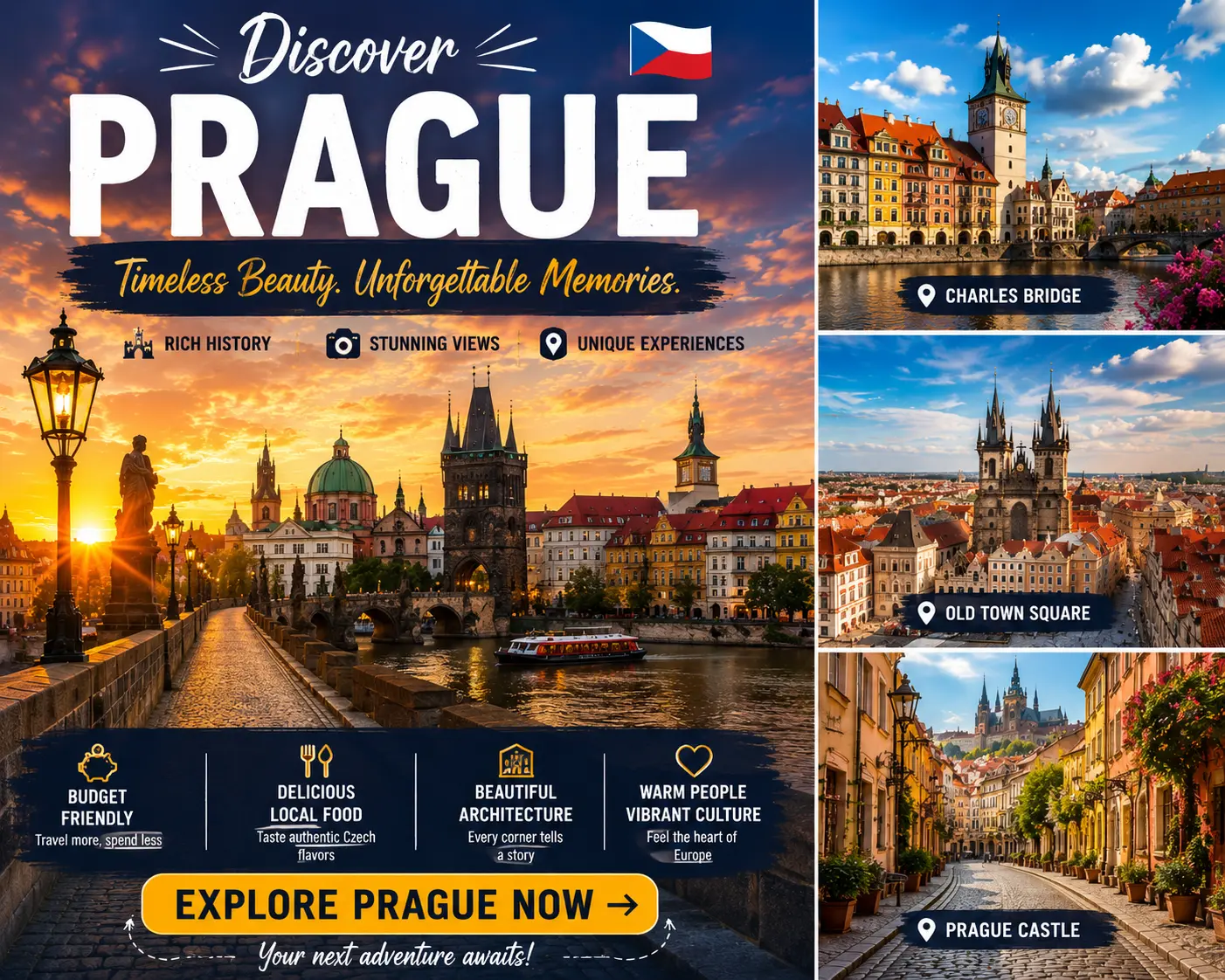
The city still gives budget-conscious travelers something that many expensive European capitals do not: a large part of the experience takes place in public spaces. You can cross Charles Bridge, wander through Malá Strana, explore castle courtyards, walk beside the Vltava, spend an afternoon in Vyšehrad, climb Vítkov Hill, or watch the evening skyline from a park without paying admission every few hours.
That makes Prague much easier to manage when you know where to spend and where you do not need to.
The aim should not be to make every single day as cheap as possible. A trip built around constantly refusing anything that costs money stops feeling like a holiday very quickly. A better approach is to keep ordinary expenses under control so that you can comfortably pay for the experiences that actually matter to you.
Perhaps that means buying a ticket to Prague Castle because Czech history interests you. Perhaps it means choosing a private room instead of a dorm, having one memorable dinner, or stopping for coffee after several hours of walking.
Those choices do not ruin a budget.
Unplanned spending does.
Prague works best when you understand the difference.
What Does Prague Really Cost in 2026?
The Czech Republic uses the Czech koruna, usually written as CZK or Kč. The euro is not the official currency, even though some hotels, restaurants, souvenir shops, and businesses serving tourists may accept it.
For most visitors, paying directly in Czech koruna is simpler.
Cards are widely accepted across Prague, including in supermarkets, cafés, restaurants, hotels, shops, and many ticket machines. You may still want to carry a small amount of cash, but there is usually no reason to arrive with a large stack of koruna for a short city break.
The larger question is how much you should expect to spend.
There is no single daily figure that works for everyone.
A solo traveler staying in a hostel in Žižkov, walking most of the day, eating a weekday lunch menu, and choosing mostly free sights will spend very differently from someone staying beside Old Town Square, eating every meal in the historic center, taking taxis, and buying several attraction tickets..Find the Best Hotels in Prague, Czech Republic on Booking.com
The season changes the calculation as well.
A hostel bed that looks inexpensive on a Tuesday in February may cost considerably more on a Saturday in June. Christmas-market weekends can also push accommodation prices upward even though December is technically outside the summer high season.
Rather than trying to force the entire trip into one fixed amount, it is more useful to understand the categories that matter most.
Accommodation is normally the biggest expense.
Food is easier to control because Prague offers everything from bakeries and supermarket meals to neighborhood lunch menus and higher-end restaurants.
Transport is relatively predictable once you understand how the ticket system works.
Attractions are where you have the greatest flexibility. Prague has enough free areas that you can choose one important paid sight without feeling as if you missed the city.
For reference, these are useful 2026 prices to keep in mind:
| Ticket or Expense |
2026 Price |
|---|---|
| Hostel dorm |
€15–50 per night, depending on season |
| Weekday lunch menu |
145–195 CZK |
| Coffee |
55–95 CZK |
| Local beer, 0.5L |
55–80 CZK |
| Typical backpacker daily budget |
About €50–70 per person, excluding flights |
| 30-minute transport ticket – PID Lítačka app |
36 CZK |
| 30-minute transport ticket – paper |
39 CZK |
| 90-minute transport ticket – PID Lítačka app |
46 CZK |
| 90-minute transport ticket – paper |
50 CZK |
| 24-hour transport pass – PID Lítačka app |
140 CZK |
| 24-hour transport pass – paper |
150 CZK |
| 72-hour transport pass – PID Lítačka app |
340 CZK |
| 72-hour transport pass – paper |
350 CZK |
| Prague Castle Main Circuit – adult |
450 CZK |
These numbers are best treated as planning ranges rather than promises. Accommodation changes sharply with season and availability, while food and drink prices depend heavily on whether you are eating in a residential neighborhood or directly beside one of Prague’s busiest attractions.
A €50–70 daily backpacker budget is therefore better understood as a practical starting point rather than a strict target. Someone staying in an inexpensive dorm, walking extensively, eating simply, and choosing mostly free sights may spend toward the lower end. A traveler adding several paid attractions, nightlife, or a more expensive hostel during peak season will naturally move above it.
That is why Prague budgeting is less about memorizing prices and more about knowing where your money is going.
If accommodation is reasonably priced and you avoid paying premium tourist-area prices every time you become hungry, the rest of the trip becomes much easier to manage.
Your Travel Dates Matter More Than Small Savings Later
Before spending hours comparing cafés or trying to save a few koruna on individual journeys, look carefully at your dates.
Accommodation can change dramatically between weekdays and weekends.
Summer brings long days, warm evenings, outdoor cafés, and good walking weather, but it also brings large visitor numbers. June, July, and August can be expensive, particularly around Friday and Saturday nights.
Spring and early autumn often provide a better balance.
April, May, September, and October are comfortable months for travelers who expect to spend much of the day outside. Temperatures are generally easier for walking than in the height of summer, although good weather can still attract plenty of visitors.
Winter has its own advantages.
January and February may offer better accommodation prices if you do not mind cold temperatures, shorter daylight hours, and the possibility of snow or rain.
Prague remains very visitable during winter. Public transport continues to operate, cafés and restaurants provide plenty of places to warm up, and museums and historic interiors are available when the weather becomes unpleasant.
December is different.
Christmas markets attract visitors, especially around weekends, and accommodation prices can rise quickly.
Do not assume that winter automatically equals low season.
The smartest approach is simply to compare real dates.
If you have some flexibility, check the cost of arriving on Thursday, Friday, Sunday, and Monday.
Moving the trip by one or two nights can sometimes save more than any budget trick you will use after arriving.
Getting to Prague Without Turning the Flight Into the Biggest Expense
Prague is well connected to other European cities, so travelers usually have several ways to reach it.
Low-cost airlines can provide excellent fares, particularly if you travel light.
The mistake is focusing only on the first number displayed on the booking page.
A cheap fare can become much less impressive after adding baggage, seat selection, priority boarding, and other extras.
If you travel with only a small personal item, the basic fare may genuinely be good value. If you need a larger cabin bag or checked luggage, compare the final total with other airlines before booking.
Flight times matter too.
A late-night arrival can lead to additional transport costs, more complicated hotel check-in, and a first evening that disappears before the trip has really started.
An extremely early return flight can create the opposite problem.
You may save money on airfare but need to leave your accommodation before normal daytime transport becomes convenient.
The better question is not simply, “Which flight is cheapest?”
Ask, “Which journey gives me the best total value?”
Travelers arriving from outside Europe sometimes save money by flying into a major European hub and booking a separate connection to Prague.
This can work, but independent tickets come with risk.
If the first journey is delayed and you miss the second flight, the connecting airline may have no responsibility for rebooking you.
A self-transfer only makes sense when you leave enough time for delays, baggage collection, terminal changes, and security.
Prague is also connected by train and bus to several major Central European cities.
If you are already in Berlin, Vienna, Dresden, Bratislava, Budapest, or another nearby destination, traveling overland can sometimes be easier than returning to an airport.
A train may cost slightly more than a headline low-cost airfare, but it can also take you from one city center directly to another without airport transfers or baggage restrictions.
Sometimes convenience is worth more than the smallest possible saving.
Where You Stay Can Change the Entire Trip
Accommodation is where Prague budgets most often go wrong.
Many first-time visitors search immediately around Old Town Square because it looks like the obvious place to stay..Find the Best Hotels in Ljubljana and Lake Bled on Booking.com
There is nothing wrong with that choice if the price works for you.
Being able to walk back to your room after dinner has value.
But Prague is not a city where you need to sleep beside the Astronomical Clock to enjoy a short visit.
The tram and metro system make several neighborhoods outside Prague 1 easy to use as a base.
The cheapest room in the city is not automatically the best deal, either.
If you save a small amount but spend forty minutes traveling in and out every morning and evening, that saving may stop feeling worthwhile.
When you compare accommodation, open the map and look at the nearest tram or metro stop.
Check whether you can reach the historic center directly or whether every journey requires multiple changes.
Then look at what surrounds the property.
A supermarket, bakery, café, and simple restaurant within walking distance can make everyday spending much easier to control.
A slightly more expensive room in a useful location may be better value than the lowest-priced option on the edge of Prague.
Hostels Still Work Well for Solo Travelers
Prague has been part of the European backpacking circuit for years, and the hostel market reflects that.
Solo travelers have plenty of options, from quiet dorm-style accommodation to highly social properties.
Price should not be the only factor.
Read recent reviews and look for practical details.
Does the property have lockers?
Can you check in at the time your flight arrives?
Is there a kitchen?
Do guests complain about noise?
Is the atmosphere heavily party-focused or more relaxed?
These things matter once you are actually there.
The RoadHouse Prague has been known for its social, communal atmosphere.
Sir Toby’s Hostel in Holešovice offers another option outside the heart of the historic center.
Onefam Home, formerly Hostel One Home, has traditionally attracted solo travelers who want an environment where meeting other people is relatively easy.
Those names can help you start comparing, but accommodation changes over time. Management, facilities, prices, and atmosphere can all shift.
Current guest reviews should matter more than any old recommendation.
Couples should also compare dorm beds with private rooms before booking.
Two hostel beds during a busy weekend can sometimes approach the cost of a simple double room elsewhere.
A private room with breakfast, a refrigerator, or basic cooking facilities may also save money in other parts of the trip.
Žižkov: Residential, Lively and Easy to Reach
Žižkov is one of the first neighborhoods many budget travelers discover when looking outside central Prague.
It sits east of the historic core and feels noticeably different from Old Town.
The streets are residential and hilly in places, with apartment buildings, cafés, bakeries, pubs, small restaurants, and ordinary local businesses.
It is sometimes described as a cheap neighborhood, but that description should not be taken too literally anymore.
Žižkov has become popular, and Prague in general has become more expensive.
Its real advantage is that you are surrounded by a wider range of everyday businesses rather than restaurants designed almost entirely for short-term visitors.
That gives you more choice when eating, buying groceries, or simply stopping for a drink.
Tram connections make it straightforward to reach central Prague, while Vítkov Hill provides an excellent free walk and viewpoint nearby.
For someone who wants a more casual base without being far from the main attractions, Žižkov remains worth considering.
Vinohrady Offers a Different Balance
Beside Žižkov, Vinohrady feels greener and more polished.
It is known for residential streets, attractive architecture, cafés, restaurants, parks, and neighborhood squares.
Accommodation here is not always cheap.
The area is desirable, and prices can reflect that.
What makes Vinohrady useful is the combination of location and atmosphere.
You can reach central Prague easily during the day and return somewhere calmer in the evening.
Jiřího z Poděbrad Square is one of the area’s recognizable gathering points, while nearby Riegrovy Sady becomes especially pleasant toward sunset.
A reasonably priced room in Vinohrady can be an excellent compromise between convenience and avoiding the busiest tourist streets.
Holešovice, Karlín and Smíchov Add More Options
Holešovice lies north of central Prague and combines residential streets with cafés, restaurants, cultural spaces, and useful tram connections.
It does not look like the postcard center, which can actually be part of its appeal.
Check the exact location before booking because convenience changes from one part of the neighborhood to another.
Karlín is closer to the center and has become increasingly popular for cafés, restaurants, bakeries, offices, and residential streets.
It is no longer a hidden bargain, but if you find a competitive rate it can offer excellent transport connections and easy access to central Prague.
Smíchov, on the western side of the Vltava, is more practical than picturesque in some areas.
That is not necessarily a disadvantage.
Supermarkets, shopping, restaurants, trams, and metro connections make everyday life easy, and the neighborhood gives you convenient access toward Petřín and Malá Strana.
The important point is not that one of these districts is always cheaper than the others.
Prices change constantly.
Compare them all for your actual dates.
Prague Public Transport Is Simple Once You Understand One Rule
Prague is a city where renting a car rarely makes sense for a normal short visit.
The places most travelers want to see are accessible by walking, metro, tram, or bus.
Parking creates an unnecessary extra concern, especially if most of your time will be spent in central areas.
The transport system is based on time.
You are not buying a ticket for one individual ride.
As long as your ticket remains valid, you can make eligible transfers between trams, metros, and buses.
This makes the system easy once you know which duration you need.
The 30-minute ticket works for shorter journeys.
The 90-minute ticket is better if you need more time or several transfers.
The 24-hour pass is useful when you expect repeated journeys throughout one day.
The 72-hour pass can be convenient for a longer city break, particularly when you are staying outside the center.
Do not buy the 72-hour pass automatically simply because your visit lasts three days.
Prague is very walkable.
On some days you may use transport only once or twice.
Calculate based on your itinerary.
The PID Lítačka App Has One Important Rule
Digital tickets through the PID Lítačka app can be convenient and are slightly cheaper than their paper equivalents.
The important detail is activation.
A digital ticket does not become valid immediately at the exact moment you press the activation button.
There is a one-minute activation period.
That means you should activate the ticket at least 60 seconds before boarding a tram or bus or before entering the paid area of the metro.
Do not wait until you see an inspector before activating it.
By then it is too late.
That one-minute detail is easy to overlook, particularly for first-time visitors, but it matters.
Once your digital ticket has become valid, you can use it normally for the duration you purchased.
Paper Tickets Need the Same Attention
A standard paper ticket bought in advance generally needs to be validated when you begin your journey.
Metro stations have validation machines near the entrance to the paid area, while trams and buses have validators for passengers beginning their trip.
Once the ticket has been stamped with its start time, do not validate it again during every transfer.
It remains valid until the purchased time period expires.
Some tickets purchased through certain onboard or electronic machines may already be valid from the moment of purchase.
Check what has actually been issued.
The safest habit is to understand the ticket before you begin traveling rather than trying to solve the problem after an inspector appears.
Ticket checks are a normal part of Prague’s transport system.
An unvalidated ticket sitting in your pocket does not protect you if validation was required.
Arriving From Prague Airport
Václav Havel Airport Prague does not have a metro station directly inside the terminal.
Most budget travelers therefore use an official surface connection combined with the metro or another airport transport service.
The best option depends on where you are staying.
If your hotel or hostel sits near a convenient metro or tram connection, public transport may be easier than expected.
If several people are traveling together with heavy bags, a taxi or ride-hailing service may become more reasonable once the cost is divided.
Late-night arrivals deserve extra planning.
Check how you will reach your accommodation at the actual arrival time rather than assuming the same daytime connections operate unchanged throughout the night.
There is no prize for choosing the cheapest transport option when you are exhausted and carrying heavy luggage.
Budget travel allows room for convenience when convenience is genuinely useful.
Petřín Funicular in 2026
Petřín Hill requires a little extra attention because information from older Prague guides may no longer be accurate.
Following reconstruction, passenger service on the Petřín funicular is scheduled to resume on 22 September 2026.
The fare rules are also different from ordinary short public transport journeys.
Standard 30-minute and 90-minute Prague tickets are not valid for the funicular.
Valid 24-hour and 72-hour Prague passes can be used without an additional fare. Otherwise, a single funicular ride costs 100 CZK, or 90 CZK when purchased through the PID Lítačka app.
Because 2026 has involved reconstruction and changes to operations, check the current operating situation before making the funicular essential to your itinerary.
If it is unavailable, walking up Petřín remains an option.
On a comfortable day, the climb through the park can be part of the experience rather than merely transport..Find the Best Hotels in Prague, Czech Republic on Booking.com
Food Is Where Travelers Often Spend More Than They Realize
Prague can feel inexpensive at breakfast and strangely expensive by dinner.
The reason is often location.
Visitors naturally become hungry while standing near Old Town Square, Charles Bridge, Prague Castle, or other heavily visited areas.
Restaurants positioned there know that many people value convenience.
There is nothing wrong with paying more for a location if you genuinely want the experience.
Sitting somewhere beautiful during a holiday can be worth money.
The problem appears when every meal is chosen that way.
Before sitting down, look at the menu.
Check food prices and drink prices. See whether side dishes are included or ordered separately.
Ask yourself whether you actually want to eat there or simply stopped because you were tired.
Often you do not need to go far to find more choice.
Moving one or two streets away from the busiest route can change the situation.
Look for the Denní Menu
One of the most useful phrases for travelers trying to eat well without overspending is denní menu, meaning daily menu.
Many Czech restaurants offer a shorter weekday lunch selection.
The exact dishes change.
You may find soup, goulash, schnitzel, roast meat, dumplings, sauces, or other straightforward meals.
These menus are aimed largely at lunch customers rather than people settling in for a long evening meal.
They can therefore provide better value than ordering from the regular menu.
Do not worry if the board is written in Czech.
A translation app can deal with that in seconds.
This opens up more possibilities than relying only on restaurants with large English-language signs outside.
A filling lunch can also change the rest of your food budget.
You may find that after a substantial midday meal, you only want something simple in the evening.
Traditional Cafeterias Can Be Useful
Not every Czech meal needs table service.
Traditional self-service cafeterias, often described as jídelna, are useful when you want straightforward food without turning lunch into a long event.
You choose from the available dishes, collect the meal, and pay.
Havelská Koruna is one of the better-known examples in central Prague.
It is not a hidden secret. Many visitors know about it.
Its advantage is simply that the cafeteria format can provide a practical alternative to a full-service restaurant when you are already sightseeing nearby.
Elsewhere in the city, similar simple lunch spots can be found in neighborhoods where local residents work and live.
Bakeries Deserve More Attention Than They Get
A bakery can solve breakfast without forcing you to sit in a café every morning.
Bread, pastries, sandwiches, and savory baked items are convenient when you want to start sightseeing early.
This works particularly well before an early walk across Charles Bridge or a morning visit to Prague Castle.
You can always have a proper café breakfast on another day.
The point is to decide which meals are worth turning into an experience and which ones simply need to keep you going.
Supermarkets Are Best Used Strategically
Prague has Albert, Billa, Lidl, Tesco, and other grocery stores throughout the city.
You do not need to eat your entire trip from supermarkets to travel on a budget.
Use them for the things that are easiest to overpay for while sightseeing.
Water, fruit, yogurt, breakfast items, bread, cheese, snacks, and simple food for train or bus journeys are easy to pick up in advance.
If your accommodation has a refrigerator, keeping a few basics there makes the trip more convenient.
That leaves your restaurant budget available for meals you actually care about.
Prague Beer Is Not One Fixed Price
Czech beer has a reputation for being inexpensive, but location matters.
A normal neighborhood pub and a restaurant facing a major landmark are not going to charge the same amount.
That does not automatically mean the central restaurant is dishonest.
You are paying for location, foot traffic, and the type of business.
Check the drinks menu before ordering.
The same applies to coffee, cocktails, wine, and specialty beers.
Prague is a modern European capital. Old stories about extremely cheap drinks should not be treated as permanent price guarantees.
Tap water in Prague is safe to drink, so carrying a reusable bottle can reduce unnecessary purchases while you are walking.
Restaurant policies on serving tap water can vary, so ask if you are unsure.
Free Prague Is Not Second-Best Prague
This is where the city becomes particularly attractive for travelers watching their spending.
Many of Prague’s most memorable experiences are not consolation prizes for people who cannot afford tickets.
They are central parts of the city.
You could spend several hours moving from Old Town through Charles Bridge and Malá Strana without entering a single paid attraction and still feel that you had spent the morning seeing Prague properly.
That gives you flexibility.
You can choose the paid places that genuinely interest you rather than buying tickets simply because they appear on every travel checklist.
Charles Bridge Is Better Before the Main Crowds Arrive
Charles Bridge becomes extremely busy during the day.
Tour groups, photographers, street performers, and people moving between both sides of the river can make the bridge feel more like a corridor than a place to stop and look around.
Go earlier.
You do not need to arrive at an absurd hour unless you enjoy sunrise photography.
Simply reaching the bridge before the main sightseeing traffic changes the experience.
You have more room to notice the statues, the Vltava, the Old Town towers, and Prague Castle rising above Malá Strana.
Once you cross, keep going.
Do not immediately turn around simply because the bridge itself was your destination.
Malá Strana Is Worth Exploring Without a Checklist
The neighborhood below Prague Castle contains small streets, historic façades, churches, stairways, courtyards, and squares that are easy to miss when you are focused only on reaching the castle.
Take time to wander.
The John Lennon Wall can fit naturally into the walk.
It does not need to become a major half-day attraction.
See it if you are interested, then continue toward Kampa.
Kampa Island provides a quieter place beside the river only a short distance from some of Prague’s busiest areas..Find Cheap Flights to Prague, Czech Republic on Kiwi.com
It is a good place to slow down.
A useful budget itinerary should not replace paid attractions with a frantic list of free ones.
Sometimes the best free activity is simply having time to sit somewhere.
Prague Castle: Decide What You Actually Want to See
Prague Castle can be approached in two different ways.
You can explore the wider complex, courtyards, exterior architecture, and views without buying the main sightseeing ticket.
For many visitors, that may be enough.
Others want to see the major historic interiors.
For those travelers, the Prague Castle Main Circuit costs 450 CZK for a standard adult ticket.
That is a meaningful expense on a tight budget, but it can still be good value if the sites included are important to you.
The mistake would be buying the ticket automatically and then rushing through places you were never particularly interested in.Find the Best Hotels in Prague, Czech Republic on Booking.com
Choose deliberately.
Prague Castle can also have temporary restrictions or closures affecting individual buildings, so check current opening information before visiting, particularly if there is one specific interior you consider essential.
That simple check can prevent you from planning an entire morning around something temporarily unavailable.
Vyšehrad Offers a Different Kind of Prague
After spending time around Old Town and the castle area, Vyšehrad feels calmer.
The historic fortress sits above the Vltava and combines old walls, green space, religious buildings, viewpoints, and a famous cemetery.
Some individual areas have admission fees, but a large part of the experience comes from simply walking around.
The atmosphere is slower than Old Town.
There are fewer moments when you feel pushed from one famous sight toward the next.
That is exactly why it fits well into a three-day visit.
Take your time along the walls.
Look over the river.
Sit somewhere if the weather is comfortable.
You do not need to make every hour productive.
Vítkov Hill Shows the City From Another Angle
Near Žižkov, Vítkov Hill provides a free view that feels very different from the familiar Prague Castle panorama.
The National Monument dominates the top of the hill.
From the surrounding area, you can see residential districts, railway infrastructure, modern development, historic roofs, church towers, and the city’s surrounding hills.
It gives you a broader idea of what Prague actually looks like beyond the preserved historic center.
The hill fits naturally into an afternoon spent exploring Žižkov.
There is no reason to travel across the city solely for a five-minute photograph.
Combine places that belong together.
Riegrovy Sady Is a Good Place to End the Day
Riegrovy Sady in Vinohrady is especially pleasant toward evening.
The park offers an open view toward Prague’s skyline, and in good weather people gather on the grass to talk, eat, drink, and watch the light change.
There is no ticket and no reservation.
That makes it a useful alternative to paying for a rooftop simply because you want a city view.
Bring a snack or drink if you want one, find somewhere comfortable, and stop sightseeing for a while.
Prague does not need to fill every minute with an attraction.
The Vltava Is More Than Charles Bridge
The river runs through much more of Prague than visitors sometimes experience.
Walking beside it gives you changing views of bridges, islands, embankments, historic buildings, and the castle skyline.
It can also become part of the route between areas you were already planning to visit.
Instead of taking transport for a short distance, you may be able to follow the river and turn the journey itself into part of the day.
That is particularly useful on a short trip.
A Three-Day Prague Itinerary That Flows Naturally
The easiest way to see Prague in three days is to stop thinking of it as a collection of attractions and start thinking geographically.
Places that sit close together should be visited together.
That reduces transport, saves time, and prevents the trip from feeling like a constant race.
Day 1: Old Town, Charles Bridge and Malá Strana
Begin at Old Town Square in the morning.
The square is easier to appreciate before the busiest period of the day.
Take time to look at the surrounding buildings, the Church of Our Lady before Týn, and the Astronomical Clock.
If you want to watch the hourly display, arrive a few minutes before the hour.
From there, move gradually toward the Vltava.
Do not worry about finding the fastest possible route.
Part of central Prague’s appeal is wandering through smaller streets that were never part of your plan.
Eventually you will reach Charles Bridge.
Cross slowly.
Then continue into Malá Strana.
Explore the neighborhood rather than using it only as a path toward another attraction.
Include the John Lennon Wall if it interests you and continue toward Kampa.
By lunchtime, look at several restaurant menus rather than sitting at the first place directly beside a landmark.
If it is a weekday and a daily menu looks good, take advantage of it.
After lunch, continue exploring the western side of the river.
There is no need to buy another attraction simply because you still have several hours before dinner.
Use the afternoon to become familiar with the city.
If you become tired, take a tram.
Saving money should not mean forcing yourself to walk when you are no longer enjoying it.
In the evening, choose dinner somewhere away from Old Town Square.
If you still have energy afterward, walk beside the river and see central Prague after dark.
The illuminated skyline is part of the experience and costs nothing.
Day 2: Prague Castle, Nerudova and Petřín
Take Tram 22 toward Prague Castle in the morning.
Approaching the complex from higher ground avoids beginning the day with one of the city’s longer uphill walks.
Once you arrive, decide what kind of castle visit you want.
If you are interested in the interiors included in the Main Circuit, buy the ticket and give yourself enough time to appreciate them.
If the courtyards, exterior architecture, views, and atmosphere are enough for you, concentrate on those.
Before visiting, check whether any individual castle buildings have temporary restrictions.
After the castle, walk downhill through Nerudova Street toward Malá Strana.
This takes you naturally toward lunch.
Look for a weekday daily menu if the timing works, or choose a simple restaurant based on the menu rather than the view from the table.
Continue toward Petřín Hill in the afternoon.
If the funicular is operating and the fare makes sense for you, use it.
If not, walk through the park.
At the top, explore the paths and gardens without feeling that you need to enter every paid attraction nearby.
Later, continue toward Smíchov or another nearby area for dinner.
This changes the rhythm of the evening and moves you away from the streets where you have already spent much of the trip.
Day 3: Vyšehrad, Žižkov and Vinohrady
Begin your final morning at Vyšehrad.
After two days around Prague’s busiest historic areas, the quieter atmosphere feels refreshing.
Walk the grounds, explore the fortifications, take in the views, and give yourself time to enjoy the open space.
Have lunch nearby or move toward the eastern side of the city before eating.
Then head toward Žižkov.
Walk through the neighborhood and make your way toward Vítkov Hill.
From the viewpoint, the city begins to make more sense as a whole.
Afterward, continue into Vinohrady.
There is no single monument that you must reach here.
The value comes from seeing residential Prague after spending two days around the historic center.
Walk the streets, stop for coffee if you feel like it, and make your way toward Riegrovy Sady.
If the weather cooperates, finish your final evening there.
You have now seen Old Town, Charles Bridge, Malá Strana, Prague Castle, Petřín, Vyšehrad, Žižkov, Vinohrady, the river, parks, viewpoints, and several different sides of Prague without buying tickets every few hours.
That is what a well-planned budget trip should feel like.
Avoiding Money Mistakes Without Becoming Paranoid
Prague does not require travelers to treat every transaction as suspicious.
Most purchases are completely straightforward.
Still, a few situations deserve attention.
Currency exchange is one.
A booth advertising zero commission does not automatically offer a good rate.
The exchange rate matters more than the sign outside.
Before handing over cash, have a rough idea of how many Czech koruna you should receive.
If the amount seems significantly worse than expected, there is no reason to continue the transaction.
ATMs create a different issue.
A machine may offer to convert your withdrawal into your home currency before charging the card.
That can look convenient because you immediately understand the amount.
The conversion rate may not be attractive.
When you are clearly given the choice, completing the transaction in Czech koruna generally allows your own bank or card provider to handle the conversion.
Check ATM fees before confirming as well.
If the displayed charge is unreasonable, cancel and look for another machine.
Check Restaurant Bills Calmly
Before ordering food, read the menu carefully enough to understand what you are buying.
Check drink prices.
Look at whether side dishes are included. When the bill arrives, spend a moment checking it. If you see something you do not recognize, ask.There is no need to assume every mistake is deliberate.
Most problems are easier to solve when you remain calm and ask for an explanation.
Tipping is also relatively straightforward.
Many people round the bill or leave a modest amount for good service.
Five to ten percent can be a useful reference when you are satisfied, but large tips are not automatically expected.
Check whether anything has already been added before including more.
Trdelník Is Optional, Not a Requirement
Central Prague is full of shops selling trdelník.
The rolled pastry is often coated in sugar and cinnamon and may be filled with ice cream, chocolate, fruit, or other toppings. If you want one, have one.
There is nothing wrong with enjoying food that is popular with visitors.
The important thing is not to assume it is automatically cheap or that eating it is necessary to have an authentic Prague trip.
Elaborate versions sold in the busiest areas can cost considerably more than a simple bakery snack.
Choose it because you want it, not because you think Prague requires it.
Prague Works Well for Solo Travelers
Prague is easy to navigate independently.
The center is walkable, public transport covers the city well, and most major attractions do not require a tour.Find the Best Hotels in Prague, Czech Republic on Booking.com
Solo travelers who want to meet people can choose social hostels.
Those who prefer their own company can spend days walking through neighborhoods, visiting parks, sitting in cafés, exploring museums, or following the river without feeling unusual.
Crowded places still require ordinary awareness.
Keep your phone and wallet secure around busy attractions and on packed public transport.
Close bags properly and pay attention when people are pressed closely together.
There is no need to spend the trip worrying about theft. normal big-city habits are usually enough.
Frequently Asked Questions
Is Prague expensive in 2026?
Prague is more expensive than its old backpacker reputation suggests, particularly when it comes to accommodation and restaurants in the most visited areas.
It can still offer good value compared with several major Western European capitals.
The final cost depends heavily on where you stay, where you eat, how many paid attractions you choose, and when you visit.
Can Prague still be visited on a limited budget?
Yes.
Start with accommodation because that is usually the expense with the biggest effect.
After that, use public transport sensibly, walk when the route itself is enjoyable, eat some meals outside the most tourist-focused streets, and take advantage of free parks, viewpoints, neighborhoods, castle courtyards, and river walks.
Can I use euros?
Some businesses accept euros, but Czech koruna is the official currency.
Paying in CZK generally makes it easier to understand exactly what you are spending.
Do I need much cash?
Usually not.
Cards are widely accepted.
A modest amount of cash can still be useful, but most short-stay visitors do not need to carry large amounts.
Is tap water safe in Prague?
Yes.
Tap water is safe to drink.
A reusable bottle is useful on long sightseeing days and can reduce unnecessary spending on bottled water.
Do I need a car?
No.
For a normal city break, walking and public transport are easier.
Parking can create more inconvenience than freedom.
How many days do I need?
Three days gives a first-time visitor enough time to see the main historic areas and still explore neighborhoods outside the center.
Two days can work if Prague is part of a longer trip.
Four or five days gives you more time for museums, slower mornings, and day trips.
Is the 72-hour transport pass automatically worth buying?
No.
It depends on where you stay and how much public transport you expect to use.
If you stay near the center and enjoy walking, individual tickets may be enough.
If your accommodation is farther out and you expect several journeys each day, the pass becomes more useful.
How early should I activate a PID Lítačka ticket?
Activate a digital ticket at least one minute before boarding or entering the metro paid area.
The ticket only becomes valid after the one-minute activation period.
Is Prague Castle worth the 450 CZK ticket?
For travelers interested in Czech history and the major castle interiors, the Main Circuit can be worth paying for.
If your interest is mainly the atmosphere, exterior architecture, courtyards, and views, you can still enjoy a substantial visit without purchasing the main ticket.
Check current opening conditions before visiting because individual buildings may occasionally have temporary restrictions..Find Cheap Flights to Prague, Czech Republic on Kiwi.com
When is Prague cheapest?
January and February can offer better accommodation prices if you are comfortable with cold weather and shorter days.
Parts of late autumn and early spring can also offer good value.
December is not automatically inexpensive because Christmas-market demand can raise prices.
Is Prague worth visiting in winter?
Yes, if you dress for the weather.
Museums, cafés, restaurants, historic streets, pubs, and public transport continue to make the city easy to explore.
Winter also creates a different atmosphere from summer.
Is Prague suitable for a weekend?
Yes.
For a two-day trip, focus on Old Town, Charles Bridge, Malá Strana, Prague Castle, and perhaps one area outside the historic center.
Trying to see everything in forty-eight hours usually makes the trip less enjoyable.
Final Thoughts
Prague is no longer the almost unbelievably cheap European capital described in many older travel stories.
That version of the city has changed.
What has not changed is how much Prague gives you before you ever reach for your wallet.
You can walk across Charles Bridge in the morning, wander through Malá Strana, explore parts of Prague Castle, follow the Vltava, climb Vítkov Hill, spend time in Vyšehrad, cross residential neighborhoods, and watch the skyline from Riegrovy Sady without building the day around entrance fees.
That creates space in your budget.
You can use the money you save on the things that matter personally to you.
Perhaps you want to see the interiors of Prague Castle.
Perhaps you would rather have a comfortable private room.
Maybe food matters more to you than museums, or you want one excellent dinner after two days of simpler lunches.
There is no single correct Prague budget.
A good budget reflects what you care about.
Spend less where spending more adds little.
Pay more where it genuinely improves the trip.
Walk when the walk itself is interesting.
Use the tram when your feet need a break.
Eat a weekday lunch menu when it looks good, and sit down for a more expensive dinner when you actually want the experience.
Buy breakfast from a bakery one morning and stop at a café the next.
That balance is far more useful than trying to force every day under one fixed amount.
Prague rewards travelers who slow down enough to notice the spaces between its famous attractions.Find the Best Hotels in Prague, Czech Republic on Booking.com
An almost empty bridge early in the morning. A tram passing through a residential street. A quiet corner of Vyšehrad. The view from Vítkov. A simple Czech lunch. The Vltava at dusk. People gathering on the grass in Vinohrady as the city turns orange behind them.
Some of those moments cost money.
Many do not. A thoughtful Prague budget leaves room for both.
✅ Travel Deals You Should Check
- ✅ Get the best flight deals and save money ✈️
Discover unbeatable flight deals - ✅ Find top-rated hotels at the best prices 🏨
Browse affordable flight options - ✅ Compare travel options instantly 🔎
Compare cheap flights worldwide - ✅ Discover amazing tours and experiences 🌍
Find budget-friendly airfare - ✅ Stay connected anywhere with travel eSIM 📶
Search the best flight prices - ✅ Protect your trip with reliable insurance 🛡️